Connected sports records
Season reference · 2025–2045
Year by year
Drew did not play from 2034 through 2036. The Chargers went 2–15, 1–16 and 5–12 during those seasons.
01 / Biography
Life and background
Texas and the first overall pick
Drew visited Texas and immediately fell in love with the university and the city. The decision was easy. His relaxed, outwardly easygoing college personality carried into his first NFL years.
He was the clear No. 1 quarterback prospect. The Chargers traded from No. 22 to No. 1 with Tennessee specifically for him, sending the 2025 No. 22 pick, their 2026 and 2027 first-round picks, and their 2027 second- and third-round picks.
Drew was grateful that Los Angeles believed in him enough to make that move, but acknowledged that the price added pressure to perform.
Growing up with the Walls name
Drew was naturally more easygoing than Jaxson. He acted as though criticism did not bother him, while privately absorbing outside opinions much more deeply than he showed.
Mac was his childhood GOAT, someone he genuinely liked and admired. The problem was not Mac or Jaxson personally: almost every success became a comparison with one of them. Drew wanted recognition as a standalone player.
Mac did not fully understand how deeply that affected him, but offered simple advice: “Just be yourself. Don’t try to be someone else.”
The first Chargers stint · 2025–2033
Drew consistently played good football and kept Los Angeles competitive without immediately becoming an all-time-level quarterback. As the first overall pick acquired for a huge package, Jaxson’s brother and Mac’s cousin, he faced expectations that made an otherwise celebrated career seem disappointing. He gradually began to think of himself as the family’s disappointment.
In his second season, Drew reached Super Bowl LXI and lost to Jaxson’s Rams. Losing a championship to his brother while becoming the losing side of a historic three-peat made it one of his most painful career moments.
First retirement and the Chargers’ collapse
Drew retired after 2033 under the accumulated weight of comparisons, public debate, pressure and self-doubt—not because of one game or comment. He initially said he had “lost his passion,” while acknowledging that he questioned whether he was good enough.
He did not regret leaving: “Nothing positive would have came from staying.” At that point, stepping away was necessary. He completely left football for three seasons.
Without him, the Chargers went 2–15 in 2034, 1–16 in 2035 and 5–12 in 2036. By his return, Los Angeles was effectively begging him to come back. There was no meaningful quarterback competition; the starting job was immediately his.
Jaxson’s reaction to retirement and the 2037 comeback
The brothers were competitive but very close, with no serious resentment. They could have an ugly argument and soon be joking again. Drew never blamed Jaxson for the comparisons.
Jaxson was disappointed by Drew’s retirement and had a hard time understanding why public opinion affected him so much. He repeatedly asked Drew “why he cares so much” and told him, “am one hundred times more hated and you don’t see me whining, that’s your problem you shouldn’t give a fuck what anyone else thinks, your opinion is the only one that matters, Not mine, not the media, not some fans on twitter, what you think is all that matters”
That advice eventually became one of the biggest influences on Drew’s comeback. He took Jaxson’s words seriously and learned to stop measuring himself through everyone else’s opinion of him.
Drew missed football, had time to reevaluate his identity, and finally took that advice to heart. In 2037 he returned because he wanted to play, not to win approval. Ironically, he became better at following Jaxson’s advice than Jaxson himself. Drew publicly jokes about his brother’s inability to leave an argument unfinished.
Corey Rhodes and a better quarterback
After returning, Drew was more confident, his pre-snap processing improved substantially, and he mastered operating from the pocket. Offensive coordinator Corey Rhodes was central to that development.
Corey became Drew’s favorite person from his football career overall. Drew trusted him immensely. He remained focused on playing quarterback rather than personnel decisions or organizational politics.
Nate Fox
Drew’s favorite player and teammate was Nate Fox, a 6’3” deep-threat receiver and his favorite target. As Drew improved at identifying defenses and working from the pocket, Fox provided a trusted vertical weapon.
Leadership and competition
Drew was a vocal, supportive captain without being gentle for its own sake. He could tell a struggling teammate, “You were ass,” then spend hours watching film with him to work out how to improve. His bluntness was meant to solve problems, not humiliate.
He held himself to the same standard and admitted bad performances without excuses. He loved on-field trash talk; competition brought out a more confrontational side than his easygoing public personality suggested.
2039: first championship
Drew led the 12–5 Chargers to Super Bowl LXXIV, defeating Tanner Thompson’s San Francisco 49ers for his first championship.
2043: Co-MVP and a championship
By 2043, Drew genuinely believed he was one of football’s best quarterbacks. The impostor syndrome that helped drive his first retirement was no longer a defining part of him. Co-NFL MVP was an accomplishment he owned rather than dismissed as luck.
Winning Super Bowl LXXVIII and its MVP award was one of the happiest moments of his life. By then, Drew had already worked through the self-doubt that contributed to his first retirement.
His GOAT opinion
Drew grew up ranking Mac first, but later considered Jaxson the GOAT. He insists that this is not brother bias and will explain his complete reasoning to someone genuinely interested.
When a listener dismisses him with “Of course you’d say that. He’s your brother,” Drew usually stops. He sees no point arguing with someone who has already decided his opinion cannot be legitimate. Unlike Jaxson, he does not need the last word.
McCauley Rules and Bountygate
Drew takes a middle position on the McCauley Rules: player safety matters, but implementation must be carefully developed and properly enforced. “If you’re gonna add something this important, don’t half-ass it or there’s no point.” He never made it a personal crusade.
Drew knows the truth about Bountygate but refuses to discuss it publicly. He neither publicly defends Jaxson nor lies or rewrites events. His answer to questions is simply: “No comment.”
Rachel, private life and broadcasting
Drew is married to Rachel Walls and has no children. Outside football, he enjoys golf, fishing and basketball.
As he grew more comfortable with himself, Drew became extremely outgoing and talkative. He enjoys interviews, podcasts, fan events and football programs because he genuinely loves discussing football. Broadcasting after his final retirement was a natural transition.
Final retirement · 2045
Drew’s final retirement came from satisfaction rather than doubt. He had proved what he needed to prove to himself and was comfortable with his career.
He was proud of being a Walls without needing to become another Mac or Jaxson. His final AFC Championship appearance closed a career he could appreciate on its own terms.
02 / Career & Football Identity
The player and the résumé
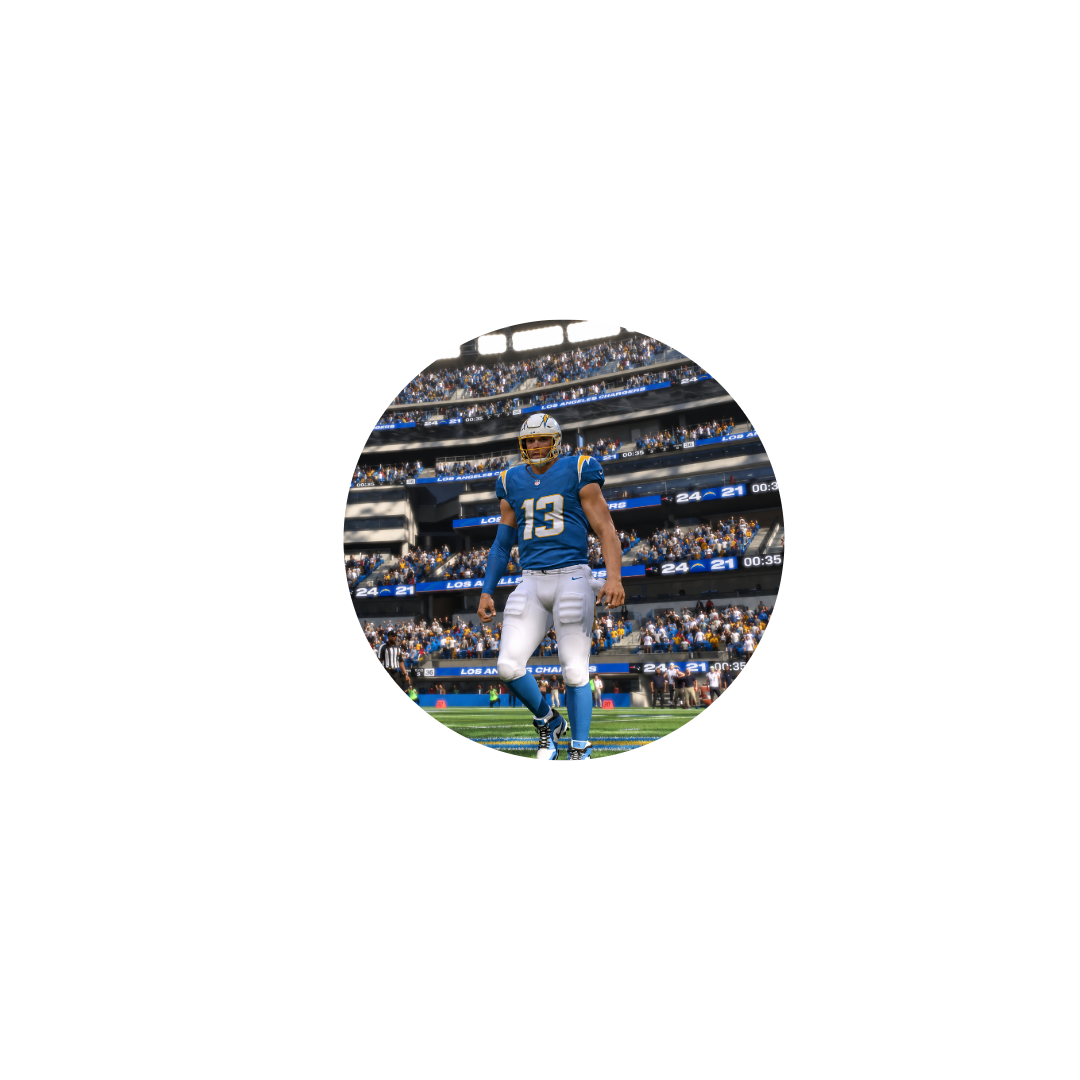
Drew played eighteen seasons across two nine-year Chargers stints: 2025–2033 and 2037–2045. He spent the intervening three seasons fully retired from football.
Jaxson’s younger brother and Mac’s cousin wanted to be discussed as Drew Walls, not as another extension of his family. His comeback became a story of confidence, improved quarterback play and an identity he no longer needed outsiders to validate.
Super Bowl history
Drew threw for 353 yards and three touchdowns in the 31–27 victory over San Francisco in LXXIV. His winning 29-yard touchdown pass to Nate Fox came with 46 seconds remaining. He won Super Bowl MVP.
03 / Personality
The person behind the record
Easygoing, increasingly outgoing and confident, Drew can explain his view, hear disagreement and move on. He almost always has something to say, but rarely needs the last word.
A supportive, blunt captain and enthusiastic trash-talker, he pairs honest criticism with practical help and applies the same honesty to himself.
04 / Relationships
People in the record
Everitt Walls and Monica Hamlin
Drew is Everitt Walls and Monica Hamlin’s younger son. Everitt believed Drew had always been an elite quarterback. Drew’s retirement in 2033 confused him, and he struggled to understand the self-doubt behind it. His reassurance about Drew’s talent did little to help.
Jaxson’s challenge to Drew’s concern with other people’s opinions proved more useful. Everitt celebrated Drew’s return in 2037 and his championships following the 2039 and 2043 seasons. He occasionally joked about feeling jealous of his sons’ rings.
Jason Harris
Jason Harris became the Chargers’ head coach in 2023 and helped develop Drew after his selection first overall in 2025. He accepted Drew’s retirement after 2033 without trying to change his mind. Harris was fired following the Chargers’ 2–15 season in 2034.
05 / Legacy & Analysis
What the life and résumé mean
Drew’s first retirement followed years of self-doubt; he left the game satisfied after his second Chargers stint.
His two nine-season stints total eighteen NFL seasons. The 193–113 regular-season record excludes the Chargers’ three seasons during his retirement.